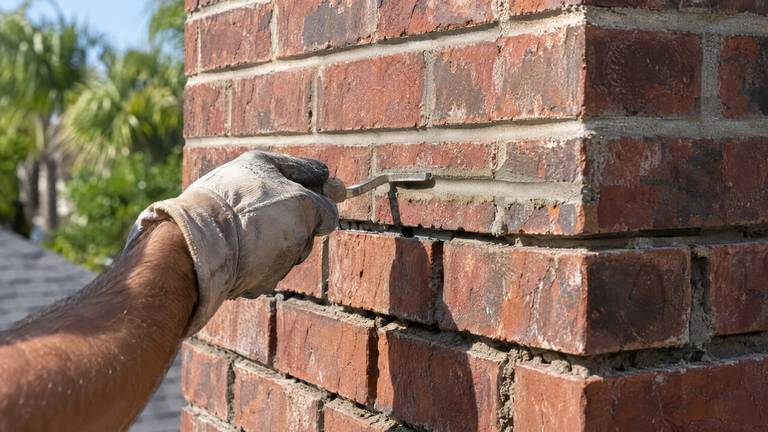
Chimney tuckpointing that preserves Tampa brickwork
Renew deteriorated mortar joints while retaining sound bricks and respecting the existing masonry.
- Family owned and operated
- Same-day service available
- No hidden fees
- Workmanship warranty
Contents
Repair the joints that have actually deteriorated
Chimney mortar joint repair addresses the material between the bricks. It does not replace a brick whose face or body has failed. Our assessment distinguishes these conditions so useful masonry can be retained without pretending every defect is a joint problem. The proposed work identifies the areas that need attention.
Homeowners often use chimney tuckpointing and chimney repointing to describe this work. In practical repair terms, the important question is how deteriorated mortar will be removed and replaced. A thin smear over the outer surface is not equivalent to preparing a sound joint. We explain the proposed method in terms of the existing condition.
Choose mortar for the bricks it will sit beside
A stronger or harder mortar is not automatically a better repair. The new material must be compatible with the retained masonry. Inappropriate joint material can change how moisture and movement affect the bricks around it. Our selection considers the existing construction rather than treating all chimney mortar as interchangeable.
The Brick Industry Association’s mortar guidance concerns clay-brick masonry. It helps frame the compatibility decision but does not supply one universal mix for every repair. Earlier repairs can also differ from the original joints. Those differences should be considered before choosing another material for the same chimney.
Preparation protects the edge of each brick
Removing failed mortar requires care around retained brickwork. Aggressive removal can damage the very material the repair is meant to preserve. The joint needs an appropriate base for new mortar without unnecessary loss of sound masonry. We consider the condition and access before deciding how the work should proceed.
If removal reveals more deterioration than was initially visible, we explain that finding. The right response may be a wider joint repair or replacement of an affected brick. It should not be an unexplained layer placed over loose material. You can then decide on the actual repair needed.
Movement and water entry need separate attention
A recurring crack through a repaired area can indicate that repointing alone has not addressed the underlying concern. Movement, failed top details or another water path may need assessment. Chimney mortar repair should follow the cause as far as it can reasonably be established. Repeating the same patch without understanding the change can repeat the problem.
Where the chimney has loose sections or a wider structural concern, joint work may be only part of the solution. We identify that limitation before recommending a cosmetic finish. Keep people clear of falling material and do not climb to test loose bricks yourself. The repair plan should reflect the condition of the whole affected area.
Set expectations for the finished joints
Joint profile, color and the appearance of retained brick influence the finished result. A new repair may not look identical to older weathered mortar immediately. Discuss appearance before work begins, especially where earlier repairs have created several different finishes. Compatibility remains important alongside the visual match.
- Identify which joints are included rather than assuming the whole stack is being repointed.
- Ask whether damaged bricks need separate replacement.
- Discuss the intended joint profile and appearance.
- Follow the repair material’s curing and protection requirements.
Repointing your chimney in Tampa
A Tampa joint-repair visit can help you retain useful brickwork while renewing the mortar that has failed. Tell us whether the joints have been repaired before and whether pieces are falling or water is entering. Previous repair information can help explain why a particular section looks different. Our family-owned team will distinguish the joint work from any additional masonry repair.
After repair, keep the work details for future maintenance. If new cracks or loose material appear, describe their position rather than covering them with another surface patch. A later assessment can then compare the changed condition with the repair performed. Sound joint work should remain part of an ongoing, understandable maintenance history.
What Deserves a Closer Look
Open or crumbling joints can leave sound brickwork without the surrounding mortar it needs. Our Tampa chimney tuckpointing service assesses the joints, the bricks and the cause of deterioration before proposing repairs. We explain where repointing is appropriate and where damaged bricks or movement need different work. A free inspection gives you a clear starting point.
- Mortar missing between otherwise sound bricks
- Loose joint material falling from the chimney
- Earlier joint patches separating from the wall
- Deeply weathered mortar around selected bricks
What's Included
What Goes Into Your Repair Plan
- Condition and depth of failed joints
- Compatibility with retained brick and mortar
- Careful removal and joint preparation
- Finish, curing and adjoining defects
Make your first service go further
Get 10% off your first service. Start with a free inspection and choose the work your fireplace needs.

Proudly American
A clear scope, an agreed price and workmanship we stand behind.
Our Services
Services for Connected Problems
-
-
-


Put That Fireplace Problem on the Schedule
Arrange your free inspection in Tampa. We will help you understand the problem and the work it needs.
Your request is confirmed
Our team will contact you to arrange the appointment.